Blog
The Spotlight is Finally On Us
December 04, 2025

Anjali Gupta
Founder & Fractional CMO
December 09, 2025
All Blogs The Unified GTM Leader: Why Sales, Marketing & CS Must Align
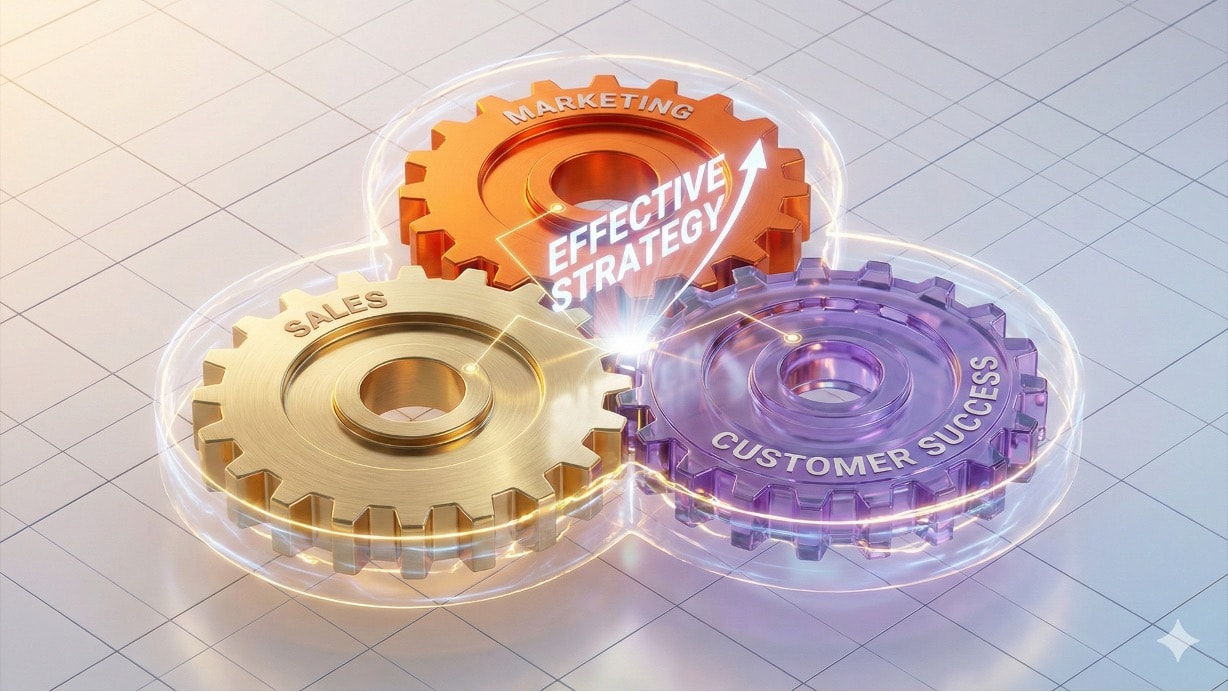
The buyer journey has changed, but org charts haven't. Understand why unifying Sales, Marketing, and CS under one leader is key to unlocking revenue velocity.
For years, organizations have operated as if they are running three separate companies within one. We have treated Sales and Marketing as separate tribes. They chase different targets, stare at different dashboards, and often operate with completely different definitions of success.
The result? Friction. Inefficiency. And a disjointed customer experience where Marketing generates leads that Sales ignores, and Sales closes deals that Customer Success struggles to retain. The uncomfortable truth is that while the buyer journey has changed fundamentally, our organizational charts & processes have remained frozen in time.
We are living in a new reality where the first 70% of the buying journey happens before a Sales representative ever enters the room. Buyers are self-educating through digital channels, peer networks, and analyst reports long before they request a demo. In this environment, the old model of "handoffs", where Marketing throws a lead over the wall to Sales, is no longer sufficient. We need a "handover." We need harmony. We need one GTM engine piloted by one leader.
When your Go-To-Market (GTM) strategy is fragmented, your message becomes inconsistent, and your credibility suffers. If Marketing is telling a story about innovation, but Sales is selling on price, and Customer Success is focused solely on technical support, the customer receives a fractured, disconnected experience.
To win in the modern B2B landscape, every campaign, conversation, and case study must tell the same story. The content that attracts a prospect should also be the material that equips Sales to close them. The campaign that builds awareness must also be designed to actively influence the pipeline.
When Marketing and Sales are architected under a single leader, you achieve true alignment between storytelling and selling, the twin levers of modern growth. Metrics stop being siloed. It's no longer about "Marketing Qualified Leads" versus "Sales Accepted Leads"; it becomes about shared outcomes.
While aligning Sales and Marketing is a common conversation, there is a function that most organizations forget to integrate: Customer Success (CS).
In today's recurring-revenue economy, Customer Success is not merely a post-sales support function—it is a critical mid-funnel growth engine. Your best growth story begins with your happiest customer. When CS is siloed, you lose the most powerful lever for new business: advocacy.
When CS, Sales, and Marketing report to one GTM leader, the magic happens:
Retention becomes your strongest marketing asset.
Expansion becomes your most efficient sales motion.
Advocacy becomes your new acquisition engine.
This creates the complete GTM loop: Brand leads to Demand, which converts to Revenue, which secures Retention, which feeds back into Brand.
This alignment is particularly critical in the Indian context. India's enterprise market is notoriously complex: it is multi-stakeholder, hybrid, and ecosystem-driven. A single deal often involves multiple stakeholders within the company, and partners influencing the outcome across different cities and agendas.
If your GTM is fragmented in such a complex market, you end up chasing shadows. A unified leader ensures that every touchpoint - whether digital, human, or partner-led, syncs toward one outcome - Revenue Velocity.
A common objection to this model is bandwidth: How can one single person lead such large, distinct teams? Sales, Marketing, and CS have different DNAs and different rhythms.
The answer is that they cannot, unless they lead differently.
The unified GTM leader isn't a "Doer-in-Chief." They are an Integrator-in-Chief. Their job is not to micromanage every function but to architect the system. They think in loops, not lanes. Think of them as the chief conductor of an orchestra, not the soloist on every instrument.
Whether you call this role Chief Growth Officer, Chief GTM Officer, or Chief Revenue Officer, the title doesn't matter, the ownership does. You don't remove the specialized Sales Heads or CMOs; you align them under one North Star so that the organization moves faster, learns faster, and grows stronger.
Alignment ensures a seamless customer journey, reduces churn, and accelerates revenue growth. When these three functions operate as a "well-oiled machine," data flows freely, customer messaging is consistent, and internal friction is eliminated, leading to higher efficiency and profitability.
Revenue Operations (RevOps) acts as the connecting tissue between Sales, Marketing, and Customer Success. It unifies data, processes, and technology across these departments to break down silos. RevOps ensures that all teams are working toward the same revenue goals using the same metrics and insights.
Misalignment leads to wasted budget, poor lead quality, and lost revenue opportunities. Marketing may generate leads that Sales cannot close, while Sales may ignore leads that Marketing spent resources nurturing. This "blame game" creates inefficiencies that directly hurt the bottom line.
Common signs of silos include inconsistent customer messaging, a lack of shared data or dashboards, frequent internal conflicts over "lead quality," and a disjointed handoff process from Sales to Customer Success. If your customer has to repeat their story to three different people, your teams are siloed.
A Fractional CMO brings an external, unbiased perspective to the C-suite. They can audit existing processes, implement unified KPIs, and restructure the GTM strategy to ensure Marketing isn't just "coloring in" but is strategically driving revenue alongside Sales and CS.
December 09, 2025
How relevant and useful is this article for you?